Over the weekend, a Saturday Essay caught my eye. Ben Sasse, a junior U.S. senator from Nebraska, published an editorial in WSJ detailing how more and more millennials are stuck in a phase dubbed perpetual adolescence. I realize I stand at a unique perspective from this essay; I was born in the late '80s so I am technically considered a "millennial," yet I see more of the qualities listed in the editorial in my current students than I do my peers. I'm afraid my students may find Neverland and simply refuse to learn #adulting skills. An intervention might be needed and so the Saturday Essay became our Article of the Week as a preemptive strike.
I'm sure most people have seen the terrible memes making fun of millennials; everything from their stereotypical love of Starbucks and smartphone to their inability to do any actual "work" gets a laugh. Everyone makes fun, but has anyone actually sat and thought about why millennials act this way?
This too can be applied to my dear students. One kid, last semester, showed up with one of those fidgety-spinner-things. One out of approximately five hundred in our school. Only one. Last week I maybe saw two or three more, nothing outrageous. This week I've seen more of those things spinning than I've seen dollars in my paycheck. When I've asked kids about why they have them I'm met with assertions that the fidgety-spinner-things are needed to help ________________ calm/focus/listen/relieve-anxiety, you can choose one to fill in the blank. Although I'm sure some kids might actually need them (and that's a stretch even,) most are not depending on the use of the spinners to survive. It's definitely a want.
One comparison that comes right to mind revolves around my first cell phone. I was 16 the first time I was allowed to own a cell. It came with two conditions. 1) I would have to keep my grades up and 2) I would have to pay the bill myself. Paying the bill myself meant I had to have a job. My monthly bill was $56 and some change. It covered 100 minutes of talking and 100 texts. Minutes after 9 pm were free so I told everyone I wouldn't answer until then so that I wouldn't ever go over my minutes and texting required hitting each number until the desired letter appeared. I was so proud of my little-red-flip-phone! It was something I wanted that I worked for and I was responsible for it.
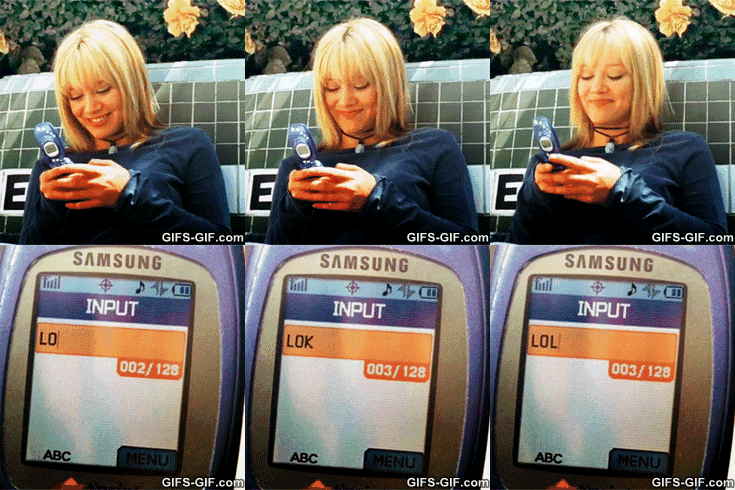
The cellphones today are far more advanced than my first phone and way more expensive. How does this compare to my story? I've noticed over the years of collecting cellular devices during testing that many students have the latest and greatest and many of those phones are beat up. Most have cracked screens and various other flaws. I would have been absolutely heartbroken had that happened to my little-red-flip-phone.
Sidenote: My first phone died a horribly tragic death my freshman year of college. It was senselessly drowned zipped in my jacket pocket as I did the laundry. RIP little-red-flip-phone!
You can infer what you like from the two stories, but in my opinion and from listening to the students, many don't appreciate the value of their cell phone. Ironic, considering students claim their life exists on their phone and each cringe and complain every time I collect them. Perhaps if more student were chipping in for the bill they would learn the value of ownership.

Ideally, students will take away one singular lesson from our AOW this week: Growing up isn't scary when you have someone there to help guide you--all you need is a can-do attitude and a willingness to work for it. I hope each one can now spot the signs and symptoms of perpetual adolescence in themselves and work to alleviate it.
 |
| Source: LinkedIn |
"Too many of our children simply don't know what an adult is anymore--or how to become one. Perhaps more problematic, older generations have forgotten that we need to teach them."Guys, I can hear my father chuckling incredulously as I write. I can hear his voice cackling, "Ha! They don't want to know anything," or "Kids today have no idea what real work is!" He's probably grumbling about how kids today just want to blame all of their problems on someone else. I love him and I know he has spent many years doing that hard labor. Although he absolutely taught me how to be an adult, there is an undeniable truth to be pointed out--our older generations did forget that behaviors must be taught and learned.
The question then becomes, how do we teach them?
I believe the editorial does a fairly good job of pointed out key places where life skills could be applied. For one: learning the difference between need and want. So many times I've caught myself making the mistake in distinction. I sometimes think I need a Starbucks Frappuccino after school some days. This is certainly not the case. My survival does not depend upon consuming that extra bit of caffeine for the day; I simply want to indulge. |
| ...caffeine |
"Part of learning to be an adult is figuring out that our real needs can be separated from the insistence call of our wants."If we encourage the distinction between the two, kids will be better prepared for adult life later on. Another way to prepare kids for life: encourage a strong work ethic.
But kids should just be kids!
I don't think anyone is arguing that kids should grow up faster, but they should learn the value of working to earn something. The editorial makes a good point that many families are so concerned with their student's educational enrichment that the value of working is lost. I understand not wanting a student's grades to slip because of having a job; but, there is something to be said for learning the value of hard work outside of academic pursuits.One comparison that comes right to mind revolves around my first cell phone. I was 16 the first time I was allowed to own a cell. It came with two conditions. 1) I would have to keep my grades up and 2) I would have to pay the bill myself. Paying the bill myself meant I had to have a job. My monthly bill was $56 and some change. It covered 100 minutes of talking and 100 texts. Minutes after 9 pm were free so I told everyone I wouldn't answer until then so that I wouldn't ever go over my minutes and texting required hitting each number until the desired letter appeared. I was so proud of my little-red-flip-phone! It was something I wanted that I worked for and I was responsible for it.
The cellphones today are far more advanced than my first phone and way more expensive. How does this compare to my story? I've noticed over the years of collecting cellular devices during testing that many students have the latest and greatest and many of those phones are beat up. Most have cracked screens and various other flaws. I would have been absolutely heartbroken had that happened to my little-red-flip-phone.
Sidenote: My first phone died a horribly tragic death my freshman year of college. It was senselessly drowned zipped in my jacket pocket as I did the laundry. RIP little-red-flip-phone!
You can infer what you like from the two stories, but in my opinion and from listening to the students, many don't appreciate the value of their cell phone. Ironic, considering students claim their life exists on their phone and each cringe and complain every time I collect them. Perhaps if more student were chipping in for the bill they would learn the value of ownership.
Whose job is it to teach #adulting?
Isn't it everyone's job? Parents, teachers, community members, society? Should we not all be encouraging young beings to develop and grown into contributing members of the human race? The whole adage of "it takes a village" is 100% true. That said, most of the burden joy falls to the parent. Education starts at home. Whether it is reading, counting, speaking, or moving, the first place a child learns to do anything is at home.
I personally consider reading to be a life long skill. It is something that is absolutely essential to adult life. I was really interested in the statistics stated in the editorial. If proven correct, adults on average only spend nineteen minutes per day reading. WHAT?! How can this be? Is this just the number of minutes spent reading for pleasure? If so, I'll accept that. If it includes time spent reading directions, recipes, emails, social media posts, text messages, etc., then we have some work to do.
So much truth is packed into such a simple sentence. Reading carefully, questioning intent, thinking critically--these are all skills humans need to live productive lives. I don't expect my students to go out and read War and Peace but I would like to know each could if he or she wanted to. I've heard so many times during ELA teacher development that one of our main jobs is to create life long readers. I agree and accept that task, but something must be said for the fact that a love of learning and a love of reading starts at home."Reading done well is not a passive activity like sitting in front of a screen."